God Hates Fags
The Supreme Court considered the strongest possible argument for an exception to the First Amendment and rejected it eight to one. The signs at Matthew Snyder's funeral were more offensive than anything you have ever read on a personal blog. The Court protected them anyway.
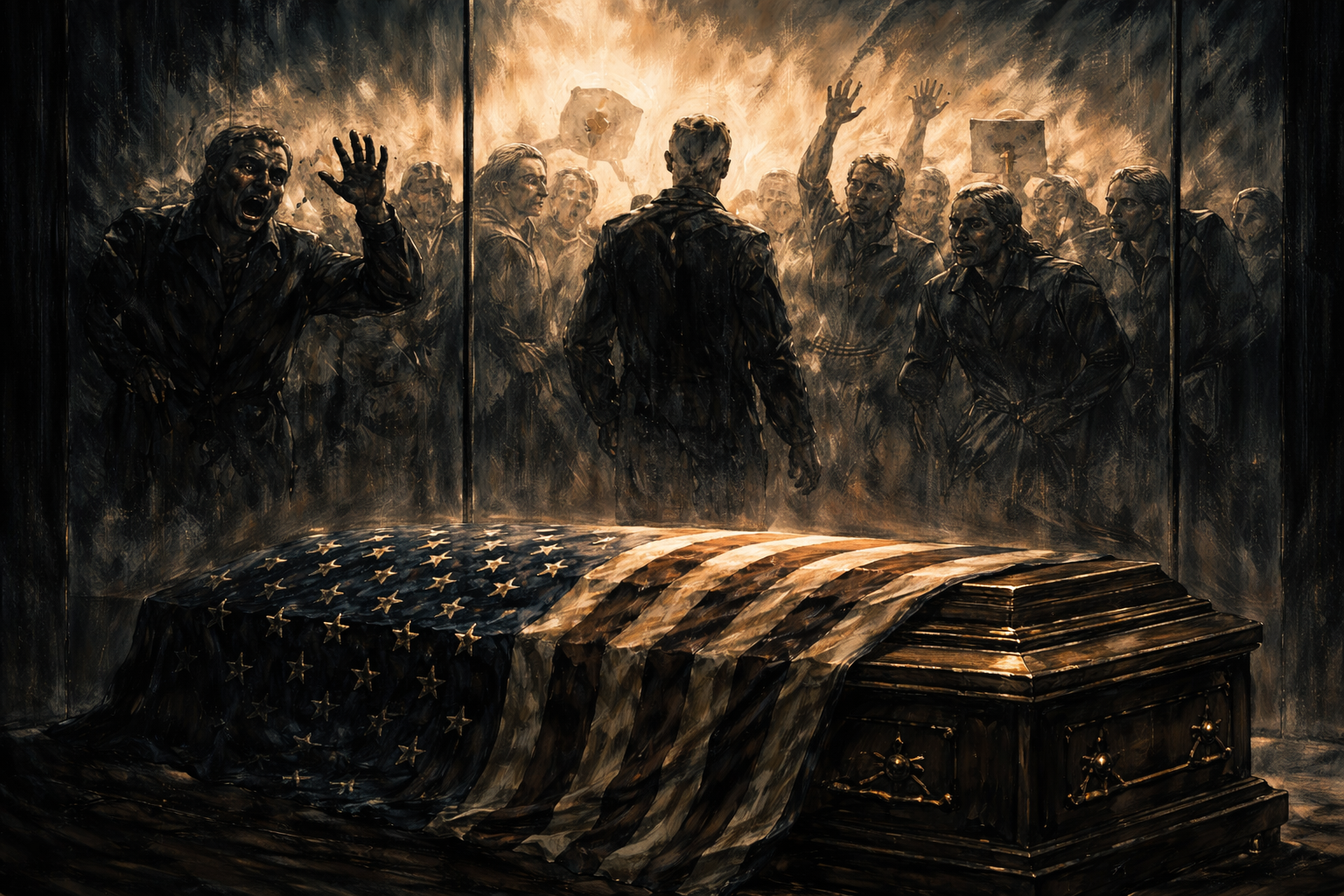
You are burying your son.
He was twenty. He was a Marine. His name was Matthew Snyder and he was killed in Iraq on March 3, 2006, when his Humvee overturned in Al Anbar Province. You are his father. Your name is Albert. A chaplain came to your door in Maryland and you knew before he opened his mouth, because fathers always know, which is one of the few things about fatherhood that nobody bothers to sell you and nobody needs to. You have spent the past week inside the specific airless grief of a parent who will outlive his child, and you are driving to St. John's Catholic Church in Westminster because there is a funeral to get through and you are the one who has to get through it.
You turn onto the road leading to the church and you see them.
About seven people. Standing on public land. They drove here from Topeka, Kansas, specifically for your son. They are holding signs. The signs say:
GOD HATES FAGS. THANK GOD FOR DEAD SOLDIERS. FAGS DOOM NATIONS. YOU'RE GOING TO HELL. SEMPER FI FAGS. GOD HATES YOU.
They will picket the funeral. They will leave. They will post a poem on their website afterward — an actual poem, they have a website, they have poems — claiming Matthew was raised to defy God and died for it. That is what they came to Maryland to say about your dead son on the day you bury him.
You sue. Of course you sue. You are a father, your son is dead, and there were signs. A Maryland jury agrees with you. The jury awards you $10.9 million. You feel, for the first time in months, that the country you buried your son for has functioning machinery. That there are limits. That a civilization cannot permit this and still call itself a civilization.
The Fourth Circuit reverses you.
The Supreme Court takes the case.
On March 2, 2011 — almost exactly five years after Matthew died — the Supreme Court of the United States rules eight to one that the Westboro Baptist Church had every constitutional right to stand near your son's casket with a sign reading GOD HATES FAGS. You get nothing. Not a dollar. The emotional harm, which everyone — everyone, including the Court — acknowledges was severe, is legally irrelevant. Chief Justice John Roberts writes the opinion. I'll quote him directly: speech is powerful. It can stir people to action, move them to tears of both joy and sorrow, and — as it did here — inflict great pain. On the facts before us, we cannot react to that pain by punishing the speaker.
You are Albert Snyder, and you are standing in the wreckage of the worst event of your life, and the highest court in your country has just looked at you, looked at the signs, looked at your dead Marine son, and told you eight to one that the picketers win.
Speech is powerful. It can stir people to action, move them to tears of both joy and sorrow, and — as it did here — inflict great pain.
— Chief Justice John Roberts, Snyder v. Phelps, 562 U.S. 443 (2011)
That is Snyder v. Phelps. That is the case. One justice dissented. Samuel Alito. He is not on your side about much, but he was on your side about this, and he lost. The other eight — liberal, conservative, Bush appointees, Obama appointees, the entire bench — agreed that Westboro's speech, at that funeral, on that day, was constitutionally protected. Not narrowly. Not reluctantly. Eight to one.
Now pull back. You are not Albert Snyder. You never were. I asked you to borrow his position for four hundred words so the doctrine would land in your body instead of your notes, and now I am returning his position to him, because it was never yours and it isn't mine. But you understand something now that you did not understand when you clicked on this essay. What you understand is this: the First Amendment does not protect speech because the speech is good. It does not protect speech because the speech is true, or kind, or helpful, or appropriate, or any other word your third-grade teacher used to describe what you were supposed to say in class. It protects speech because the alternative — a country in which Albert Snyder's grief is a legal argument that wins — is a country with no First Amendment at all. It is a country where whoever is hurt worst decides what can be said. And the Supreme Court, looking directly at the worst-hurt man in the most sympathetic posture American litigation has ever produced, said: no. Not even him. Not even now. Not even these signs.
If that ruling does not rearrange your understanding of what speech is protected in this country, you are not paying attention. You are being polite to your own ignorance. Politeness has never once in American history been a constitutional standard.
Which brings me to a type of person.
There is a particular kind of man who believes silence is always safer. You have met him. He is almost always middle management. He has almost always succeeded in his career by being agreeable rather than by being correct, and at some point in his thirties he noticed that the people who make trouble for institutions get punished more reliably than the people who cause actual harm inside them, and he built an entire worldview on top of that observation like a house on top of a shrug. When this man encounters a writer, he experiences the writer the way a building inspector experiences an unpermitted deck: a problem to be managed. He will tell you, with the full weight of his middle-management gravitas, that your writing is inappropriate. He will say the word the way a weatherman says partly cloudy — as if it were a fact about the world rather than a fact about the inside of his own skull. And if he is sufficiently well-placed, if he has sufficiently ingratiated himself to the right commissioners, the right administrators, the right HR departments, he will successfully convince those institutional actors that the First Amendment of the United States Constitution contains an unwritten exception for speech he personally finds uncomfortable.
It does not. There is no such exception. There has never been such an exception. The Supreme Court considered the strongest possible argument for one in 2011 and rejected it eight to one. The signs at Matthew Snyder's funeral were more offensive than anything any writer you have ever read has ever published about anyone. The Court protected them anyway. The man in middle management telling you your blog post crosses a line is not citing Snyder. He has not read Snyder. He has not read any case. He is citing himself and hoping — desperately, institutionally, professionally — that you will confuse his preference for a statute. He has built his entire career on people making exactly that confusion. Do not make it for him.
I am a gay man writing about my own life on my own blog. I have been told, by people with an institutional stake in my silence, that what I write is inappropriate. I want you to remember Albert Snyder standing in front of that church. I want you to remember what the signs said. I want you to remember the margin. Eight to one. And then I want you to ask yourself what word you think legitimately applies to a personal essay on a personal website, when the word inappropriate did not legitimately apply to GOD HATES FAGS at a Marine's funeral.
The Constitution already answered. It answered in 2011. Anyone still telling you otherwise is not citing law. They are citing a preference — specifically, their preference for your silence — and preferences do not override the First Amendment. Not Albert Snyder's preference, and his was earned in blood. Certainly not the preference of a commissioner who got talked into believing otherwise by a man whose entire professional skill set is talking institutional actors into believing things that are not true.
Fred Phelps died in 2014. Westboro still pickets. Albert Snyder never collected a dollar. Matthew Snyder is still dead. And I am writing this sentence.
That is not a comparison of suffering. It is a description of the doctrine. The First Amendment does not protect writers because writers deserve protection. It protects writers because the moment it stops, Albert Snyder's grief becomes the ceiling on American speech, and no country survives that ceiling.
If you do not like what I write, the Constitution has an answer for you. The answer is the same one it gave Albert Snyder.
And Albert Snyder had a much better case than you do.