Philip Tapia, Chaos Theory Studios, and $1.7 Million in Public Contracts:
What the Documents Say
Public contracting has rules. You disclose conflicts of interest. You don't award contracts to your boyfriend. You don't fabricate meeting notes to cover it up. This is what happens when the rules get ignored anyway.
Public contracting has rules. You disclose conflicts of interest. You do not steer public money to a romantic partner and then paper over the arrangement when questions start. According to court filings and public records, that is exactly what happened here.
Between 2015 and 2024, Philip Tapia's companies—Tapia Productions, Inc. and later Chaos Theory Studios, LLC—received $1,644,084.75 from Community Transit, the public transit agency serving Snohomish County, Washington. The figure comes from agency payment records and court filings. Public records productions confirm the amounts down to the cent.
That total does not include what appears to have happened earlier at Sound Transit, where the pattern allegedly began.
The Sound Transit Period (2012–2014)
According to filings in Meyers v. Community Transit et al., Case No. 2:25-cv-02463-TL (W.D. Wash.), Deanna "De" Lyn Tapia (then Deanna Meyers) worked in Sound Transit's IT department as Transit Rider Technology Manager. During that period, she authorized payments to Tapia Productions totaling at least $400,000. One June 19, 2012 change order alone was worth $40,000 for "Trip Planner improvements."
The filings allege that De Meyers and Philip Tapia were romantically involved at the time and did not disclose the relationship. Sound Transit policy required disclosure. Washington law required disclosure. The relationship was allegedly left undisclosed anyway.
Internal investigation materials cited in the filings include one especially direct line attributed to De: "If anyone found out she would lose her job."
That same set of records includes a May 2012 email from Sound Transit contracts specialist Tom Campbell describing De as "all amped up" to move Tapia's contract paperwork. Another Sound Transit employee, Sean Freyholtz, told investigators that Tapia's bid came in "dead on" to internal cost estimates—a detail that, at a minimum, drew internal attention.
The filings further allege that when De learned an audit might be coming, she spent three days creating meeting notes for meetings that never occurred. If true, that was not sloppy recordkeeping. That was fabrication.
On June 5, 2014, De resigned from Sound Transit in lieu of termination, according to the records cited in the complaint. Her departure ended one chapter. It did not end the pattern.
The Pattern Reappears at Community Transit
Community Transit hired De in fall 2014. She initially served as an IT manager and later rose to Director of IT. In 2016, the agency opened RFP 12-16 for on-call IT consulting services. Philip Tapia's companies began receiving the work.
On August 15, 2017, Community Transit's Acting HR Manager, Chris Beck, issued a written "Memo of Direction Regarding Conflict of Interest" to De Meyers, then Manager of Transit Technology. The memo, on Community Transit letterhead, copied Tim Chrobuck, Geri Beardsley, Kunjan Dayal, and De Meyers's personnel file. The memo is reproduced below from the agency's October 6, 2025 PRA production:
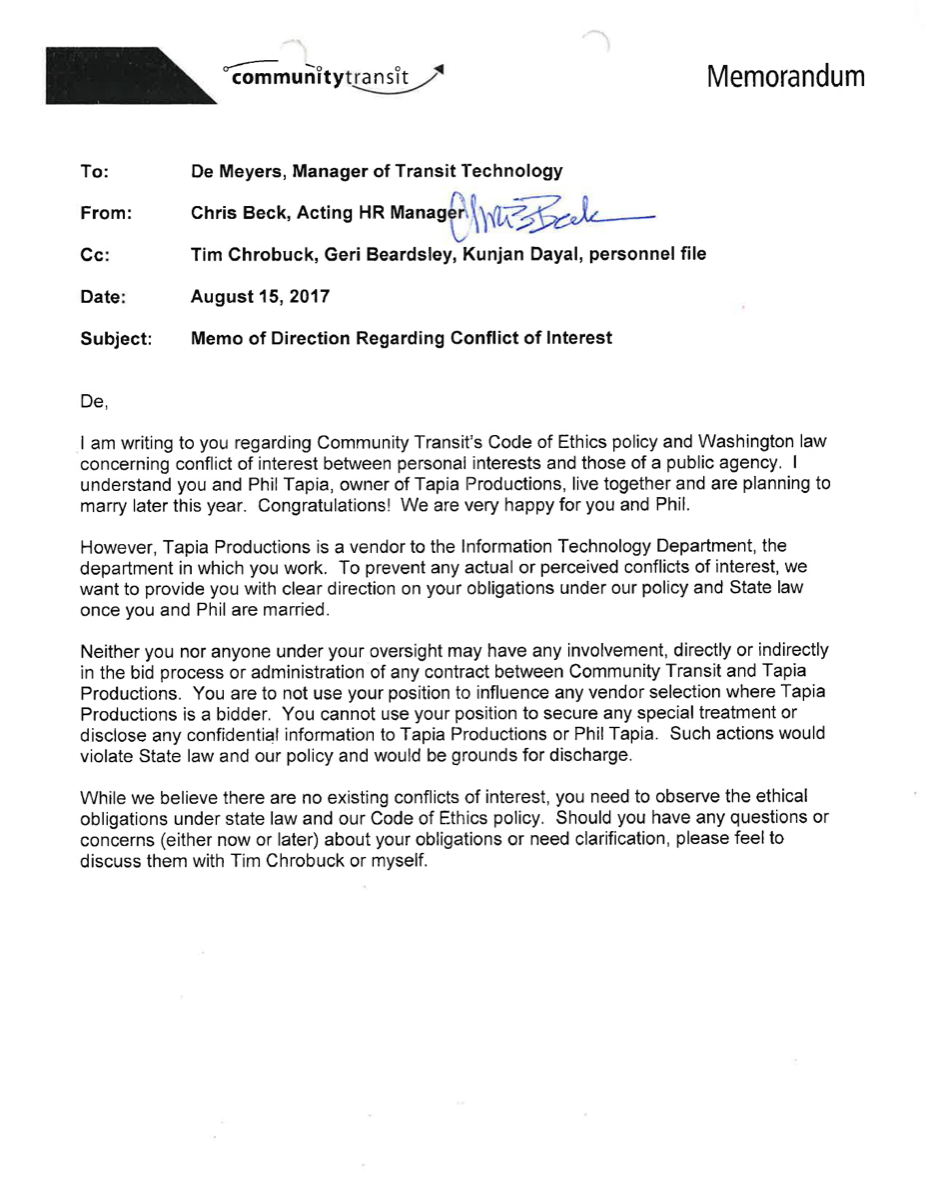
The memo directed De Meyers, in writing: "Neither you nor anyone under your oversight may have any involvement, directly or indirectly in the bid process or administration of any contract between Community Transit and Tapia Productions." It further stated: "Such actions would violate State law and our policy and would be grounds for discharge."
The Production Trail Is Its Own Evidence
The memo's own production trail demonstrates how the agency now handles records related to its IT Director.
Community Transit produced the Beck Memo of Direction in unredacted form, on its public NextRequest portal, on September 25, 2025 — as part of the October 6, 2025 installment to PRA Request 25-197. Anyone who downloaded the 25-197 production on or after that date received the memo in full text, addressee, sender, date, subject, and body intact.
Seven months later, in its May 14, 2026 production to PRA Request 26-69 — De Tapia's personnel file — the agency redacted the same memo.
Under Washington's Public Records Act, an agency cannot retroactively redact a record it has already produced unredacted on a public records portal. RCW 42.56's exemption framework is forward-looking: it tells an agency what may be withheld at the moment of production. It does not authorize the agency to un-publish records that were already publicly released. Once a record has been produced unredacted, the record is, as a matter of statutory law, public. A subsequent redaction of the same record, in a later production to the same requester, is bad-faith withholding on its face.
When the respondent flagged the prior unredacted production to Community Transit's Public Disclosure Officer, Rachel Woods, she acknowledged the prior release. The redactions in the personnel-file production were nonetheless retained. The records-administration apparatus that processed the personnel-file installment was not applying the statute neutrally. It was applying a different pressure — the same pressure that runs through every produced document in this matter: a senior agency executive who has personally directed agency staff in the handling of her family-court litigation, and a records-administration team that defers to her rather than to RCW 42.56.
The same pattern that produced the contracts also produced the redactions.
The False Certification
The contracts continued anyway. On May 30, 2019, Phil Tapia signed Community Transit Form 7.02 — a certification regarding conflict of interest, executed under penalty of perjury. He checked "no" when asked whether a conflict existed. Community Transit already had the Beck Memo in its own files when he signed it; the memo had been on the petitioner's personnel record for nearly two years.
By then, the contract ceiling had climbed substantially. The agency's own contract records, also produced under PRA Request 25-197, document that the not-to-exceed amount eventually reached $400,000 annually without competitive rebidding.
The CEO Who Signed Off
Ric Ilgenfritz became Community Transit's CEO in January 2021. Before that, he had spent years in senior leadership at Sound Transit, including during the period when De worked there.
According to the complaint, by the time Ilgenfritz took over at Community Transit, the agency's files already contained the August 15, 2017 HR memorandum documenting the conflict. De was then Director of IT. Philip Tapia still had active vendor relationships with the agency.
On January 20, 2022, Ilgenfritz signed Contract Amendment No. 6, making Chaos Theory Studios the contract entity. In March 2022, he signed Contract Amendment No. 7, increasing the contract ceiling to $400,000. The complaint alleges that both amendments required CEO-level approval because of their value, and that he signed them personally.
The Delisting That Changed Nothing
What triggered the delisting was an email from the day before. On March 9, 2023, at 12:59 p.m., Community Transit's Digital Product Owner Brian Vallene wrote to procurement manager Kunjan Dayal. Phil Tapia had asked to meet about the contract. Internally, the conflict of interest had just been raised by another employee. Vallene wanted Dayal to know — and looped in CC Mike Berman, Chad Jorissen, and Larry Olson. Dayal replied thirty-seven minutes later. The email thread, produced by Community Transit in PRA Request 25-197 (April 23, 2026 installment), is reproduced below in full:
Hi Brian,
Can you meet with him mid next week, please. I have included others who are close to the matter. Perhaps we all should meet together first, so that we are all on the same page. I need to cover some bases with legal counsel first.
Thanks
Kunjan
On Mar 9, 2023, at 12:59 PM, Brian Vallene <Brian.Vallene@commtrans.org> wrote:
Hi Kunjan,
I got a message from Phil Tapia asking to meet. Can you summarize what you discussed with him so you and I are on the same page?
Also, while I haven't discussed this with anyone, independently Kristi Cuddy raised the conflict of interest issue with me and a broader group yesterday. I also think Larry should be in the know.
Thanks,
Brian
Brian Vallene
Digital Product Owner
O: 425.521.5355 | M: 425.248.9817
www.CommunityTransit.org
Source: Community Transit PRA Production, Request 25-197 (April 23, 2026 installment, employee email search "Tapia", 2,705 messages)
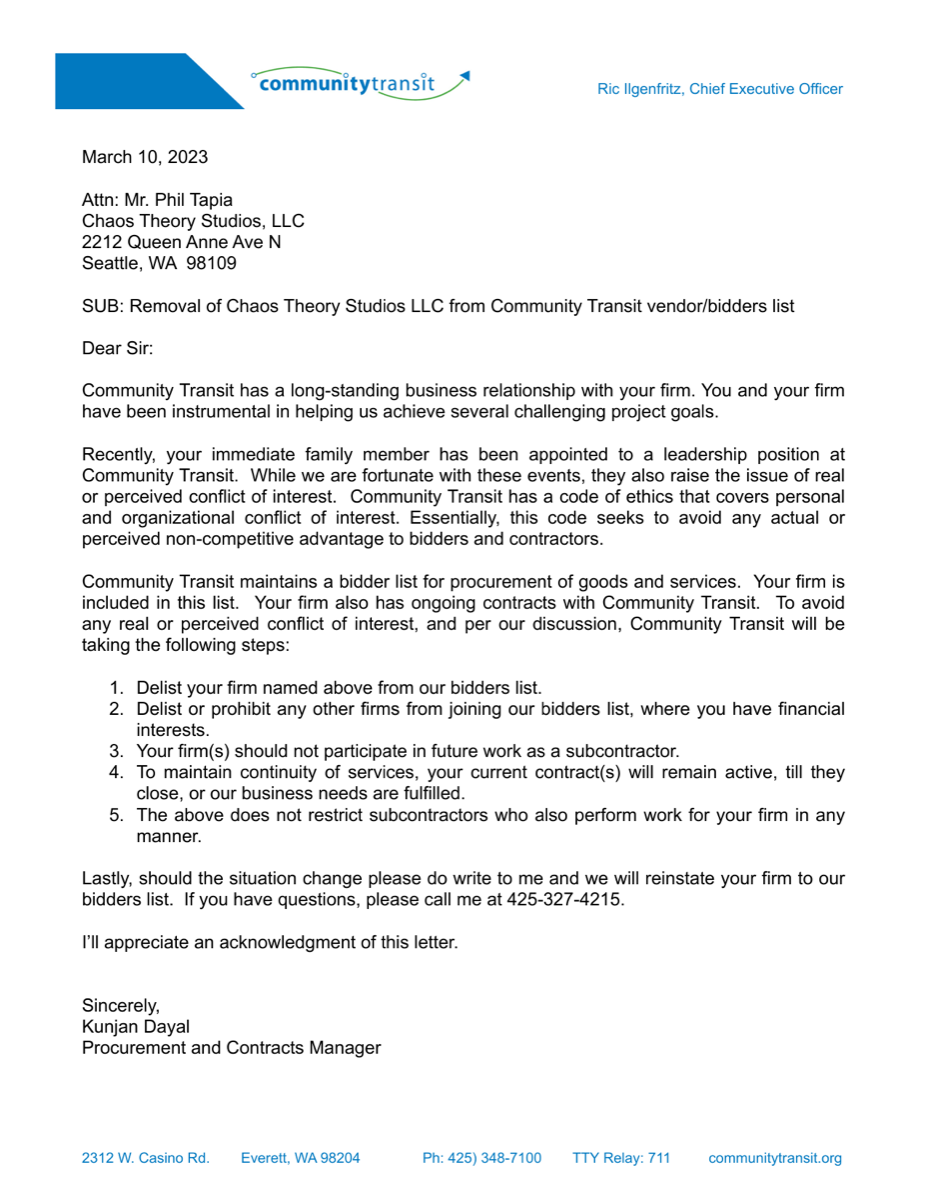
Twenty-four hours later, on March 10, 2023, Community Transit procurement manager Kunjan Dayal sent a letter formally removing Chaos Theory Studios from the agency's vendor and bidders list. The reason stated in the letter was direct: "your immediate family member has been appointed to a leadership position at Community Transit," creating a real or perceived conflict of interest.
The letter, on Community Transit letterhead and produced by the agency in PRA Request 25-168, is reproduced below in full:
That sounds decisive until you read the rest.
The letter barred future participation but allowed existing contracts to continue until closure or until the agency's "business needs" were satisfied. It also left open the possibility of reinstatement if the "situation change[d]."
According to agency payment records cited in the complaint, 17 additional payments totaling $319,836.10 were made to Chaos Theory Studios after the March 2023 delisting. The last recorded payment was July 24, 2024.
The vendor changed nothing meaningful. The money kept moving.
One example is the agency's own produced Purchase Order C2023395 — issued to Chaos Theory Studios under Contract #2019-051 for $225,000 in Web Developer Consulting Services. The PO postdates the delisting letter:
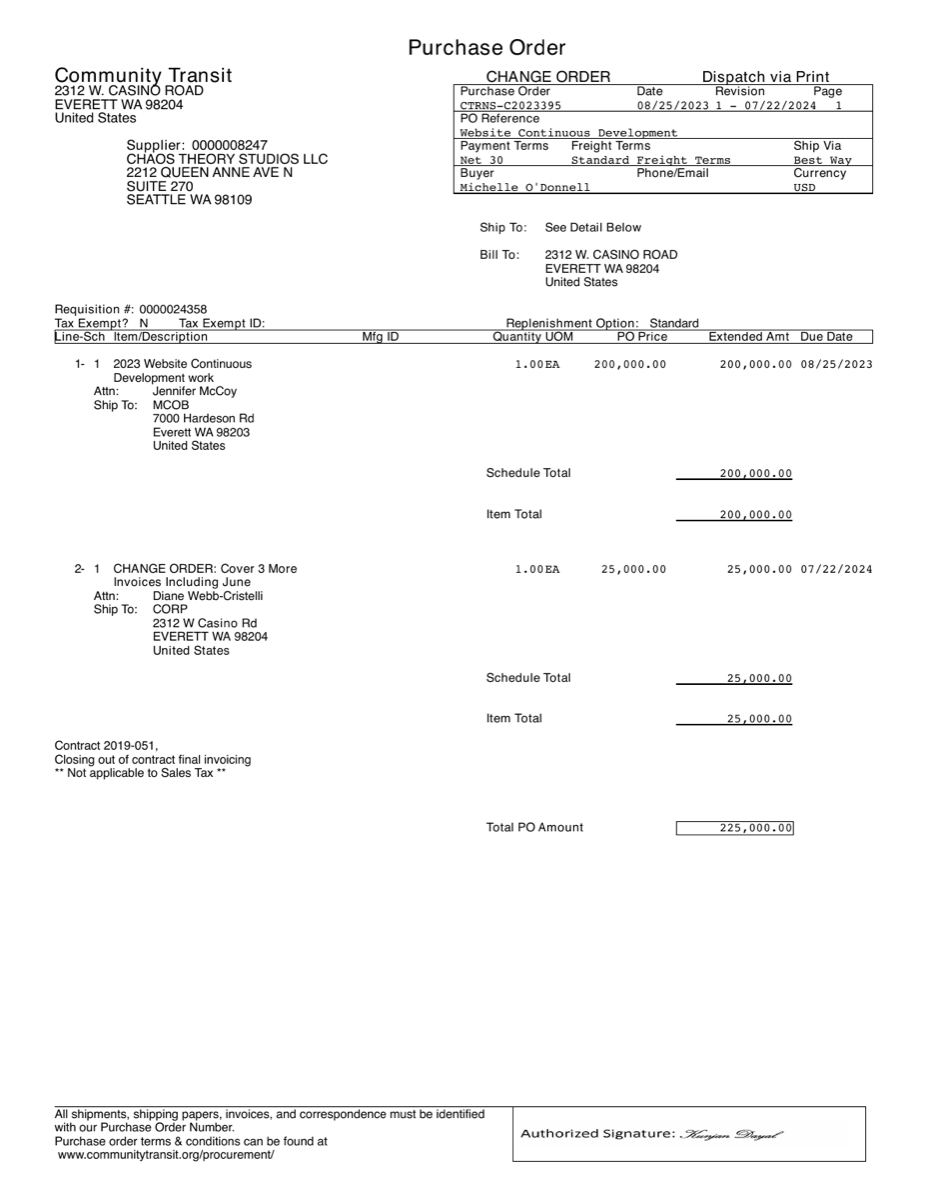
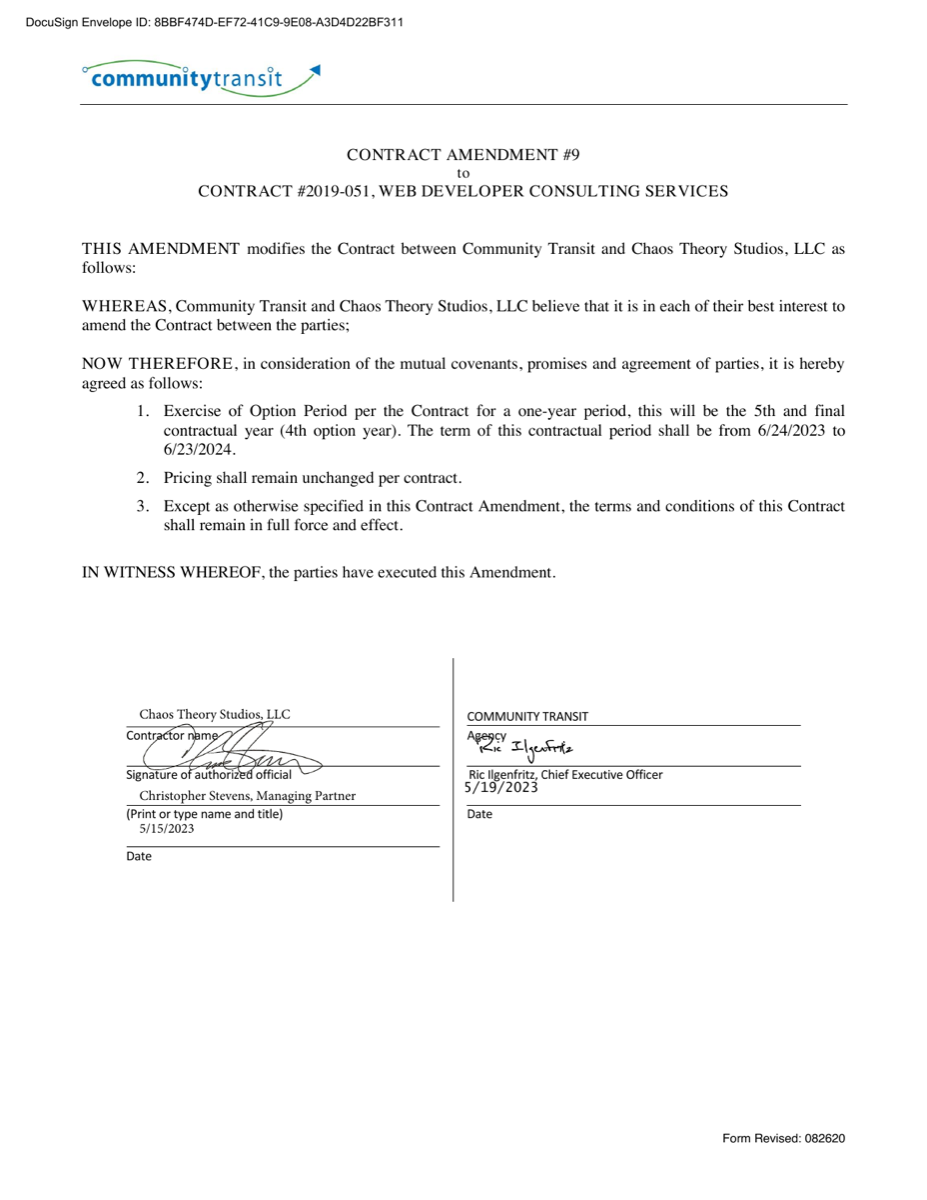
After the delisting, Christopher Stevens — Phil Tapia's business partner and co-founder at Chaos Theory Studios — began signing the contract documents. The effect was not termination. It was continuity with a different pen.
Contract Amendment #9 to Contract #2019-051 — 2019-051_CA9_Exercise_of_Option (SIGNED) — was produced by Community Transit in its September 22, 2025 PRA installment. The fully-executed amendment is reproduced below:
Stevens Was a Signature, Not a Successor
Stevens signing the post-delisting contract document did not change who controlled Chaos Theory Studios.
Chaos Theory Studios LLC filed its most recent Annual Report with the Washington Secretary of State on June 5, 2025 — more than two years after the March 10, 2023 Community Transit delisting, and the day after the petitioner filed her protection-order petition. The filing identifies two Governors of the company: Christopher Stevens and Phillip Tapia. Stevens is also the registered agent. The principal business address is a UPS Store mailbox at 2212 Queen Anne Ave N #270 in Seattle. The filing is searchable in the Washington corporations index at sos.wa.gov/corporations under UBI 604 762 398.
The delisting did not remove Phil Tapia from the entity that billed Community Transit. It moved his signature one line down on the contract page. By his own state filing, more than two years after the agency removed his name from its vendor list, he continues to operate the company that continued to receive payments from the agency that employs his wife. The agency's framing of the post-delisting period — that Stevens "took over" — is contradicted by Stevens's own corporate paperwork.
The Metadata Anomalies
The PDF files Community Transit produced under PRA Request 25-197 carry embedded metadata fields documenting who authored each document and when. The metadata is the agency's own record, embedded in the agency's own files, produced through the agency's own portal. It is not in dispute.
Five separate contract amendments produced in the September 22, 2025 installment carry Karen Fitzthum as the document author, with Microsoft Word as the creator application, spanning four years of amendment activity:
| File | Author | Creator | Created |
|---|---|---|---|
| Tapia_Amendment_for_Exercise_of_Option_10122018.pdf | Karen Fitzthum | Microsoft® Word 2016 | June 18, 2020 |
| 2019-051_CA5_Exercise_of_Option.pdf | Karen Fitzthum | Microsoft® Word for Microsoft 365 | June 10, 2021 |
| Contract_Amendment_6-Assignment_for_Name_Change.pdf | Karen Fitzthum | Microsoft® Word for Microsoft 365 | January 13, 2022 |
| 2019-051_CA7_-_Increase_NTE_to_400k.pdf | Karen Fitzthum | Microsoft® Word for Microsoft 365 | March 10, 2022 |
| Fully_Executed_2019-051_CA8_Exercise_of_Option.pdf | Karen Fitzthum | Microsoft® Word for Microsoft 365 | June 9, 2022 |
Embedded PDF metadata fields extracted directly from the produced files. Source: Community Transit PRA Production, Request 25-197 (September 22, 2025 installment, Contract #2019-051 Web Developer Consulting Services folder).
Karen Fitzthum left Community Transit in 2004. The metadata of the agency's own produced files attributes authorship of contract amendments dated 2020, 2021, and 2022 to a person who had not been employed by the agency for sixteen to eighteen years. Either someone is opening Karen Fitzthum's eighteen-year-old Word template and using it as the master document for live procurement actions — which would itself be a major document-control failure — or someone is impersonating her authorship deliberately. The agency has not yet offered a third explanation that fits its own metadata.
A separate amendment, produced in the same installment, carries a different anomaly entirely:
| File | Author | Creator | Created |
|---|---|---|---|
| 2019-051_Contract_Amendment_page_1-combined.pdf | Phil | Adobe Acrobat.com CombinePDF Service 1.0.0 | April 27, 2021 |
Embedded PDF metadata fields extracted from the produced file. Adobe Acrobat.com CombinePDF Service is a free public web service for combining PDF files — not a Community Transit internal procurement system. Source: Community Transit PRA Production, Request 25-197.
The vendor's first name appears as the document author of a Community Transit contract amendment. The "Creator" field identifies a free public PDF-combining service — not the agency's procurement system, not the agency's contract-management platform, not any tool a procurement officer would use to assemble a contract amendment in the ordinary course of business.
Metadata does not resolve every factual dispute. But when an agency's produced contract files repeatedly attribute authorship to an employee who left sixteen years before, or — in one case — to the vendor himself, with assembly handled through a free online web service, those fields are the agency's own document that something other than ordinary procurement document control was happening.
What Happened When Someone Started Asking Questions
When questions about the contracts began reaching the agency, the response was not an internal review or a procurement audit. It was a coordinated institutional reaction documented in the agency's own production trail.
On June 4, 2025, De Tapia filed for a protection order against her son in Snohomish County Superior Court. That same afternoon, at 22:05 UTC, she sent the order to multiple Community Transit officials: Scott Eastman (Risk/Legal), Veralee Estes (HR), Chas Stearns (CIO), and Jennifer Howard (HR). Two minutes later, Estes forwarded the order to Kyle Hughes (Security Services). Within forty-five minutes, the order had crossed three departments — HR, Legal, and Security. By the following afternoon, the Snohomish County Sheriff's Office Transit Police Unit was coordinating with agency security personnel. The forensic reconstruction of the distribution chain is documented in the agency's own produced communications.
On June 17, 2025 — the day before the protection-order hearing — De filed a 71-page evidence packet in state court. The packet included materials assembled by Michael Berman, Community Transit's Senior Manager of Technology Infrastructure Services, who reports directly to De Tapia. Berman compiled pages of emails with headers and metadata onto Community Transit letterhead. The agency's production confirms this work product was prepared on agency time, on agency systems, using the agency's Microsoft 365 tenant and its Barracuda email-security infrastructure.
That was not passive receipt of a private litigant's evidence. It was institutional participation.
Commissioner Susan E. Harness granted the protection order on June 18, 2025.
The Spoliation Admission
Throughout the fall of 2025, Community Transit's Public Disclosure Officer Rachel Woods repeatedly told the respondent — in writing, through the agency's NextRequest portal — that no further Teams chats responsive to PRA Request 25-123 existed.
On October 7, 2025, the agency produced one Teams chat (between Woods and Mike Berman) and represented that "there is just one Teams chat available in today's installment." On October 28, 2025, Woods wrote: "At this time we have not located any additional records responsive to this request." On November 10, 2025, Woods wrote: "We are not locating any additional documents for this request… Microsoft Teams Chat is used for transitory messages at our agency and has an automatic 30-day retention period."
That was the agency's position to the requester for five consecutive months: no further Teams chats existed, and any that ever had existed were gone to a 30-day retention setting.
Then, in a separate production released February 25, 2026 under PRA Request 25-168 Part 2, the agency itself produced a July 10, 2025 internal email from Mike Berman to Rachel Woods. In that email — written by the agency's IT Senior Manager to the agency's Public Disclosure Officer two months before the agency began telling the requester no Teams chats existed — Berman acknowledged in his own words that Teams chats between himself and his direct supervisor De Tapia had existed, and that he had disposed of them under the agency's "transitory" classification:
Rachel –
Teams Chat: Attached is the Teams chat between you and me. There was a chat with me and De, but that contained only transitory information.
Email redirect: A Microsoft 365 Exchange redirect rule was put in place to redirect any messages coming from or about Henk Meyers to any CT employees to both my mailbox and a shared mailbox with Transit Security. These were not distributed to any employees and were not acted upon. Our perimeter email defense system was then accessed to extract the original email for evidentiary purposes.
Barracuda Filtering: No filtering was put in place at the perimeter.
Please contact me if you have any questions.
Thanks.
Mike
Mike Berman
Senior Manager
Technology Infrastructure Services
Community Transit
Mike.Berman@commtrans.org | 425-521-6101
Source: Community Transit PRA Production, Request 25-168 Part 2, 2nd Installment (released February 25, 2026).
By July 10, 2025, the duty to preserve electronically stored information had unambiguously attached: a public records request specifically asking for communications between Berman, De Tapia, and others had been pending for more than a month; the state protection-order proceeding (to which the agency had supplied Berman's own work product on June 17, 2025) was concluded; and the respondent had given written notice of his federal civil rights claims. Under FRCP 37(e), destruction of relevant ESI after the duty to preserve attaches can support adverse-inference sanctions.
The agency's own document confirms three things at once.
One. Teams chats existed between Berman and his direct supervisor about the respondent. Berman's email acknowledges them.
Two. Those chats were disposed of under the agency's "transitory" retention classification. Communications between the IT Director and her direct subordinate, about her son, during the period when an open PRA request specifically sought them and his federal civil rights claims were pending against the agency, are not "transitory" by any reasonable application of records-management policy. They are exactly the records a litigation hold is designed to preserve.
Three. Berman acknowledges, in the same email, that the agency configured a Microsoft 365 Exchange transport rule to redirect "any messages coming from or about Henk Meyers" — the federal civil rights plaintiff — into Berman's own mailbox and a Transit Security shared mailbox. The surveillance infrastructure existed. The agency's IT Senior Manager configured it. He acknowledged it in writing.
The People
For readers tracking the names, here is the cast as established by the agency's own produced records and supporting filings:
Philip Tapia — Owner of Tapia Productions, Inc. and Chaos Theory Studios, LLC. Agency payment records establish that his companies received $1,644,084.75 from Community Transit and at least $400,000 from Sound Transit. He signed a Community Transit conflict-of-interest certification on May 30, 2019 marking "no" to the conflict question, despite the Beck Memo of Direction having been on file in his partner's personnel record for nearly two years at the time. He remains a Governor of Chaos Theory Studios LLC as of its June 5, 2025 Washington Secretary of State filing.
Deanna "De" Lyn Tapia (née Meyers) — Former Sound Transit manager, later Community Transit IT manager and then Director of IT. The August 15, 2017 Beck Memo of Direction was addressed to her and placed in her personnel file. The agency's own produced records establish that contracts to Philip Tapia's companies continued for the seven years following the memo, that on June 16, 2025 she emailed her own subordinate to assemble Public Records Act evidence for her personal family-court matter, and that she filed a state-court protection-order petition against her son on June 4, 2025 as the federal civil rights case against her employer reached the agency.
Ric Ilgenfritz — Community Transit CEO. By the time he took over in January 2021, the Beck Memo had been in the agency's files for more than three years. He personally signed Contract Amendment #6 on January 20, 2022 (transferring the contract entity to Chaos Theory Studios) and Contract Amendment #7 in March 2022 (raising the not-to-exceed amount to $400,000).
Michael Berman — Community Transit Senior Manager of Technology Infrastructure Services and De Tapia's direct subordinate. The agency's own production reflects that he processed De Tapia's personal-litigation PRA request in approximately two hours of elapsed time on June 16, 2025, configured a Microsoft 365 transport rule to redirect emails "coming from or about Henk Meyers" to his own mailbox and a Transit Security shared mailbox, and disposed of his Teams chats with De Tapia under a "transitory" retention classification while the federal civil rights case against the agency was pending.
Veralee Estes — Sr. Manager, Employee Engagement, Community Transit. Received the protection order on June 4, 2025 and forwarded it to security within two minutes.
Kyle Hughes — Sr. Program Manager, Security Services, Community Transit. Proposed in writing on June 4, 2025 to deny the respondent public comment at a public board meeting "per the court order despite it being unserved," and coordinated with the Snohomish County Sheriff's Office Transit Police Unit on enforcement.
Scott Eastman — Senior Manager, Security & Emergency Management, Community Transit. Received and redistributed the protection order through agency channels on June 4, 2025.
Jennifer Howard — Community Transit HR employee and former Snohomish County Courthouse employee. Received the June 4, 2025 distribution of the protection order.
Chas Stearns — Chief Information Officer, Community Transit. Issued the formal litigation hold to executive leadership on June 5, 2025.
Rachel Woods — Community Transit Public Disclosure Officer. The agency's PRA workflow ran through her office during the relevant period.
Brian Vallene — Community Transit Digital Product Owner. On March 9, 2023 he wrote to procurement manager Kunjan Dayal flagging that "Kristi Cuddy raised the conflict of interest issue with me and a broader group yesterday" — the email that preceded the March 10 delisting letter by twenty-four hours.
Kunjan Dayal — Community Transit procurement manager. Authored the March 10, 2023 delisting letter and was the procurement official Brian Vallene wrote to about the internally raised conflict.
Christopher Stevens — Co-founder and registered agent of Chaos Theory Studios LLC. Listed as Governor on the company's June 5, 2025 Washington Secretary of State Annual Report (alongside Phillip Tapia). Began signing Community Transit contract amendments after Phil Tapia's March 2023 delisting.
Matthew Hendricks — Outside counsel retained by Community Transit (Hendricks Law PLLC).
Bradley Dawes — Sergeant with the Snohomish County Sheriff's Office Transit Police Unit. Coordinated with Community Transit security on enforcement of the protection order in June 2025.
Sean Freyholtz — Sound Transit employee. According to investigation materials cited in the federal complaint, told investigators that Tapia's bid came in "dead on" to internal cost estimates.
Karen Fitzthum — Listed in the embedded metadata of five Community Transit contract amendments produced under PRA Request 25-197 as the document author. Per the agency's own employment records cited in the federal complaint, Fitzthum left Community Transit in 2004.
Bradley Dawes — Sergeant with the Snohomish County Sheriff's Office Transit Police Unit. Allegedly coordinated with Community Transit security regarding the order.
Christopher Stevens — Co-founder and registered agent of Chaos Theory Studios and business partner of Philip Tapia. According to the complaint, he began signing invoices after Phil Tapia was delisted.
Kunjan Dayal — Community Transit procurement manager who authored the March 10, 2023 delisting letter.
Sean Freyholtz — Sound Transit employee who told investigators Tapia's bid was "dead on" to internal estimates.
Karen Fitzthum — Listed in metadata as author of a 2022 contract document despite having left Community Transit years earlier.
Dan Gomez — Listed in metadata as creator of a file whose title suggests a 2019 origin but whose metadata allegedly shows 2025 creation.
What This Is
All of this appears, in one form or another, in Meyers v. Community Transit et al., Case No. 2:25-cv-02463-TL, pending in the Western District of Washington.
The case alleges a procurement pattern involving an undisclosed conflict of interest, a false conflict certification, contract expansions without meaningful competitive protection, metadata anomalies in key files, and an aggressive institutional response when questions were raised.
If the allegations are true, this is not a paperwork issue. It is a public-integrity issue. Public money is supposed to be allocated through rules, disclosures, competition, and accountability. Not through insider relationships and after-the-fact cleanup.
The contracts at issue involved public funds. The records are public records. The filings are court filings. Readers can examine them for themselves.
That is the point of transparency.
Frequently Asked Questions
What is Chaos Theory Studios? Chaos Theory Studios, LLC is a video and media production company owned by Philip Tapia and co-founded with Christopher Stevens. According to court filings in Meyers v. Community Transit et al., Chaos Theory Studios received public contracts from Community Transit in Snohomish County, Washington as a successor entity to Tapia Productions, Inc. Court filings allege the company received a combined $1,644,084.75 from Community Transit between 2015 and 2024.
How much did Philip Tapia receive from Community Transit? According to agency payment records and court filings, Philip Tapia's companies—Tapia Productions, Inc. and Chaos Theory Studios, LLC—received $1,644,084.75 from Community Transit. Filings also allege at least $400,000 in earlier payments from Sound Transit. These figures are drawn from public records productions and are cited in Meyers v. Community Transit et al., Case No. 2:25-cv-02463-TL (W.D. Wash.).
What is Meyers v. Community Transit? Meyers v. Community Transit et al. (Case No. 2:25-cv-02463-TL) is a federal civil lawsuit pending in the Western District of Washington. It alleges procurement fraud, an undisclosed conflict of interest, a false conflict-of-interest certification, and institutional retaliation in connection with contracts awarded to Philip Tapia's companies over approximately a decade.
Did Philip Tapia disclose his relationship with Community Transit? According to court filings, Philip Tapia signed Community Transit Form 7.02 on May 30, 2019—a conflict-of-interest certification filed under penalty of perjury—and checked "no" when asked whether a conflict existed. The complaint alleges this certification was false and that Community Transit already had an August 2017 HR memorandum in its own files documenting the conflict at the time he signed it.
Who owns Chaos Theory Studios? Philip Tapia is identified in court filings as the owner of Chaos Theory Studios, LLC. Christopher Stevens is identified as co-founder and registered agent. After Chaos Theory Studios was removed from Community Transit's vendor list in March 2023, filings allege Stevens began signing invoices while the contracts, entity, and revenue stream remained intact.
Was Chaos Theory Studios removed from Community Transit's vendor list? Yes. On March 10, 2023, Community Transit procurement manager Kunjan Dayal sent a letter formally removing Chaos Theory Studios from the agency's vendor and bidders list, citing a conflict of interest. However, according to agency payment records cited in the complaint, 17 additional payments totaling $319,836.10 were made to Chaos Theory Studios after the delisting. The last recorded payment was July 24, 2024.
What metadata problems are alleged in the case? Court filings allege that certain Community Transit contract documents contain metadata inconsistencies, including a 2022 contract document listing an employee who left the agency in 2004 as its author, a file with a 2019 title but an alleged 2025 creation date, and documents embedded with open-source Java libraries rather than the agency's standard financial systems. One contract amendment allegedly lists "Phil" as author and shows generation through a public PDF-combining service. These allegations are described in detail in the metadata analysis article.
Disclosure: This post summarizes allegations, records, metadata findings, and procedural events described in court filings, public-records productions, and related materials in Meyers v. Community Transit et al., Case No. 2:25-cv-02463-TL (W.D. Wash.). Allegations remain allegations unless and until proven in court. Named parties are free to respond publicly. This post is not legal advice.