The Protection Order Should Never Have Issued. It Was Prior Restraint From Day One.
On May 29, 2026, a Snohomish County Superior Court commissioner will be asked to make permanent an anti-harassment protection order whose constitutional defect was preserved on the record at the original hearing. The harassment the petition complains of is, by the petitioner's own sworn enumeration, a federal civil rights lawsuit and Washington Public Records Act requests. Both are constitutionally protected. The order was prior restraint from the day it was entered.
On June 18, 2025, at the original protection order hearing in Tapia v. Meyers, No. 25-2-05123-31, in front of Snohomish County Superior Court Commissioner Susan E. Harness, I raised the only legal argument that mattered. I raised it twice, on the record, in the correct doctrinal terms. The first time, when the commissioner read me the order's no-contact terms, my words were these:
"Okay, so to be clear, there's a prior restraint on my First Amendment rights?"
— Henk Meyers, Respondent · Source: Hearing audio, Tapia v. Meyers, No. 25-2-05123-31, Snohomish Co. Sup. Ct., June 18, 2025, ~16:09
The commissioner's response, on the record, was the following exchange, transcribed verbatim from the court audio:
"It's not a prior restraint, sir. ... I am not gonna make a legal determination. I'm telling you what this order says. You can read the order. You know what it says. If you wanna argue prior restraint, then you bring a motion. But that's not what today is for."
— Commissioner Susan E. Harness · Source: Hearing audio, Tapia v. Meyers, No. 25-2-05123-31, Snohomish Co. Sup. Ct., June 18, 2025, ~16:12–16:30
That exchange is the case.
In a single uninterrupted utterance, the commissioner of a Washington Superior Court did three legally incompatible things. She ruled that the order was not a prior restraint ("It's not a prior restraint, sir"). She then disavowed the legal determination she had just made ("I am not gonna make a legal determination"). She then deferred the constitutional question to a separate motion she knew the pro se respondent in front of her would not have the resources to bring ("If you wanna argue prior restraint, then you bring a motion. But that's not what today is for").
A judicial officer cannot, in the same breath, summarily reject a controlling constitutional doctrine, deny that she is ruling on the doctrine, and direct the respondent to bring a separate motion if he wants the doctrine actually heard. The first statement is a legal determination. The second statement contradicts the first. The third converts the determination into a deferral, while leaving the substantive order in force.
Later in the same hearing, at the substantive presentation, I preserved the constitutional objection a second time, on the record, in the doctrine's correct legal terms:
"Your Honor, this is prior restraint, unconstitutional censorship of speech before it occurs."
— Henk Meyers, Respondent · Source: Hearing audio, Tapia v. Meyers, No. 25-2-05123-31, Snohomish Co. Sup. Ct., June 18, 2025, ~30:55
The order was entered anyway.
Most adult sons in my position would not have had the technical legal vocabulary to identify the order their mother's petition was asking the court to enter. They would have argued, in plain language, that what was happening to them was unfair. They would have asked the court to consider their side. They would not, pro se, with no lawyer at counsel table, have correctly named the controlling constitutional doctrine and correctly defined it in real time on the record.
I did. My words to the commissioner were not a layman's improvisation. They were a deliberate preservation of the precise constitutional objection. I said "this is prior restraint, unconstitutional censorship of speech before it occurs" because I understood what Near v. Minnesota held, because I understood that a state-court order restraining speech in advance of its occurrence carries a presumption of constitutional invalidity, and because I understood that if I did not say the words in those terms, on that record, in that hearing, the issue would not be preserved.
The reason I knew that, sitting pro se in front of a Washington Superior Court commissioner with no attorney at the table, is that I care about the First Amendment. I care about my right to speak. I care about it in a way that has, over the past year, cost me every relationship the petitioner's institutional position made it convenient for other people to sever. The constitutional argument I preserved at the original hearing was not a procedural technicality. It was the only argument the case turned on, because the only thing the petition was asking the court to take from me was the thing the First Amendment was specifically built to protect.
A pro se litigant who correctly names a controlling constitutional doctrine and correctly defines it in real time has put the court on notice that the argument is being made with knowledge. The commissioner who heard the words I said cannot, on this record, have misunderstood what was being raised. She heard the doctrine identified by its correct name. She heard it defined. What she did with it was to summarily dismiss it ("It's not a prior restraint, sir"), then immediately disavow her own dismissal ("I am not gonna make a legal determination"), then direct the constitutional question into a separate motion ("you bring a motion"), while granting the substantive restraint the doctrine, if applied, would have forbidden.
That should not have happened. The order itself, the one entered on June 18, 2025, was unconstitutional from the moment the commissioner signed it. The defect was not the petition's renewal a year later. The defect was the petition. The defect was the original order. The defect was a Washington court entering an anti-harassment order that, by the petitioner's own sworn enumeration, reached and restrained constitutionally protected federal litigation and Washington Public Records Act activity. The renewal petition the court will consider on May 29, 2026 is not the moment a constitutional problem arises. It is the moment the same constitutional problem, persisting for a year because the court deferred it and the order's existence has been used to prevent the respondent from mounting the separate motion required to challenge it, asks the court to make itself permanent.
Under the PO 054 form on which my mother's renewal petition was filed, the burden of proof is mine — to demonstrate, by a preponderance of the evidence, that I will not continue to engage in acts of "unlawful harassment" which my mother defines, in her own sworn declaration, as my federal civil rights lawsuit and my Washington Public Records Act requests. The court is asking the respondent to carry the burden of dismantling an order that never should have been entered against him in the first place.
That is the procedural posture. An unconstitutional order entered after the constitutional argument was raised on the record and deferred. A year of the same order in operation. A renewal hearing that places on the respondent the burden of proving why the unconstitutional order should not continue. And a petition for permanence that, if granted, fixes the prior restraint as a feature of the respondent's permanent legal status by reason of his decision to continue exercising rights the First Amendment protects.
What the Order Restrains
The order entered on June 18, 2025 reaches the following categories of conduct: non-physical contact, indirect contact, third-party contact (regardless of whether the third parties have any knowledge of the order's existence), presence within a thousand feet of the petitioner's workplace, communication of any kind to or about the petitioner except as the order permits, and any speech-act that can be characterized as "harassment" within the meaning of RCW 7.105. The order has been used, in the year since, in three documented operations, each of which is captured in the public agency's own writing.
The first use. On June 4, 2025, within twenty-four minutes of the temporary order arriving in his building, Community Transit Senior Program Manager for Security Services Kyle Hughes wrote to Senior Manager for Employee Engagement Veralee Estes, copying Senior Manager for Security and Emergency Management Scott Eastman:
"I think it would be reasonable to deny any public comment from this individual per the court order despite it being unserved. I'll discuss with Scott as we may need to run it through legal and then coordinate with IT and Rachel for the board meeting."
— Kyle Hughes, Sr. Program Manager, Security Services, Community Transit · Source: Email to Veralee Estes (cc Scott Eastman), June 4, 2025, 3:30 PM PDT · Produced under PRA Request 25-123
A Washington public-agency employee proposed, in writing, to use a court order he simultaneously acknowledged had not been served on the respondent as the publicly stated basis for denying a citizen public comment at a public board meeting.
The second use. On June 6, 2025, IT Senior Manager Mike Berman wrote to Public Disclosure Officer Rachel Woods, on the agency's Microsoft Teams platform:
"Please do not act on this request at this time. A court order is in the works and Transit Security has been notified."
— Mike Berman, Sr. Manager, Technology Infrastructure Services, Community Transit · Source: Microsoft Teams chat with Rachel Woods (CT Public Disclosure Officer), June 6, 2025 · Produced under PRA Request 25-168 (Feb 25, 2026 release)
The "request" was Public Records Act Request 25-123. The "court order" was the petitioner's still-pending family-court protection-order petition. Ms. Woods, in the same chat, confirmed her compliance with the instruction.
The third use. On June 5, 2025, Snohomish County Sheriff's Sergeant Bradley Dawes of the agency's Transit Police Unit wrote to Mr. Hughes, copying Mr. Eastman, after receiving the petitioner's protection-order packet from Mr. Eastman the night before:
"Scott emailed me a service copy yesterday and I printed it out to have ready in the event the respondent does show. I also emailed my team that the expectation is to serve the respondent, and based on the conditions of the order, escort them off the property. Should the respondent not cooperate, we will enforce the order and arrest them for violation of the order."
— Sgt. Bradley Dawes, Transit Police Unit, Snohomish County Sheriff's Office · Source: Email to Kyle Hughes (cc Scott Eastman), June 5, 2025, 9:32 AM PDT · Produced under PRA Request 25-123
Mr. Hughes responded:
"Excellent, thank you."
— Kyle Hughes, Sr. Program Manager, Security Services, Community Transit · Source: Email reply to Sgt. Bradley Dawes, June 5, 2025, 9:42 AM PDT · Produced under PRA Request 25-123
Each of those three uses, on its own terms, restrains speech in advance of its occurrence, on the basis of its anticipated content, by reference to a court order. That is the textbook definition of a prior restraint. Near v. Minnesota, 283 U.S. 697 (1931). The doctrine does not become less applicable because the speaker is the petitioner's son. The First Amendment does not contain a familial-relationship exception.
What the Petition Labels "Harassment"
The renewal petition's substantive declaration is the document that establishes the constitutional defect. The petitioner enumerates, in her own sworn words, the conduct she wants the court to enjoin: the respondent's "litigation," meaning his federal civil rights action Meyers v. Snohomish County Public Transportation Benefit Area, et al., No. 2:25-cv-02463-TL (W.D. Wash., Hon. Tana Lin); and the respondent's "sustained pattern of public records requests directed at my employer," meaning his Public Records Act requests under RCW 42.56 to Community Transit. She asks the court to find that this constitutes "unlawful harassment" and to permanently restrain it.
Washington's anti-harassment statute defines "unlawful harassment" as a course of conduct that, among other elements, "serves no legitimate or lawful purpose." Each operative term is doing work. And the statute, at RCW 7.105.010, goes further. The definitional section of the very statute under which my mother's petition is being prosecuted explicitly excludes constitutionally protected activity from the definition of "course of conduct." A series of acts that consists of constitutionally protected activity is not, under the statute's own definitional language, a "course of conduct" at all. If the conduct the petition enumerates is one hundred percent constitutionally protected activity, then the petition's "course of conduct" equals zero. And without a course of conduct, the court lacks the basic subject-matter authority the statute confers to enter or renew an anti-harassment order.
Filing a federal civil rights lawsuit serves a legitimate and lawful purpose. The Petition Clause of the First Amendment, NAACP v. Button, and Bill Johnson's Restaurants v. NLRB establish that access to the courts is core protected activity. A federal cause of action under 42 U.S.C. § 1983 brought against named public officials in their individual capacities is precisely the activity Congress created the statute to enable. The litigation does not become "harassment" because the defendants find it unwelcome.
The defense will likely attempt to minimize the federal action by pointing out that it is currently navigating the mandatory pro se screening process under 28 U.S.C. § 1915(e)(2)(B). That minimization should be preempted. A § 1915 screening is a routine, non-merits administrative checkpoint designed to manage federal pro se dockets. It is not a judicial finding that the underlying claims lack substance. The procedural posture of the federal case, on its own terms, is the opposite of the picture the minimization would paint: thirteen separate public-officer and entity defendants felt compelled to retain formal counsel and file appearances before the federal court had even issued its formal summons. Defendants do not pay for early counsel and rush appearances on cases they believe to be frivolous. The agency's own response to the federal action — the speed of the retention, the volume of the appearances, the experience of counsel selected — reflects the agency's own contemporaneous assessment of the legal peril the lawsuit represents.
Filing requests under the Washington Public Records Act serves a legitimate and lawful purpose. The Legislature, in the Act's mandatory liberal-construction clause, declared that the people of Washington insist on remaining informed so that they may maintain control over the instruments they have created. Records requests to a public transit agency are exactly the activity the Act was written to facilitate. The requests do not become "harassment" because the agency would prefer not to produce.
Public commentary about the conduct of public employees, in their public-employment capacities, is the speech the First Amendment most strongly protects. New York Times v. Sullivan, 376 U.S. 254 (1964). The petitioner is the IT Director of a Washington public transit agency. Her institutional conduct is, as a matter of constitutional law, a matter of public concern. Commentary about it is not converted to "harassment" by the operation of a state-court order.
The petition asks the court to ignore all three doctrines and to label as "unlawful harassment" what the statute, the Constitution, and a hundred years of First Amendment doctrine define as legitimate and lawful activity.
There is, in the petition's own enumeration of what it seeks to restrain, no allegation of physical contact. No allegation of stalking conduct within RCW 9A.46. No allegation of any unlawful act independent of the constitutionally protected activity the petition complains of. The petition's evidentiary base, in its own catalog filed in the original proceeding, consists of text messages and emails sent during an emotionally charged family financial dispute that pre-dates the petition by days, along with a curated agency exhibit assembled by the petitioner's own institutional subordinate that included messages the agency's own email-security logs had recorded as undeliverable.
The harassment the petition complains of, examined under the statute, is not harassment within the meaning of the statute. The harassment is non-existent. The conduct the petition seeks to restrain is constitutionally protected.
The Double Standard, on the Same Transcript
The same hearing also produced a second telling moment, this one on the procedural posture of the filing itself. The petitioner filed her 71-page evidence packet the day before the hearing. I objected on the record that being asked to absorb and respond to 71 pages of new material in less than 24 hours felt like procedural ambush. Commissioner Harness's response, verbatim from the court audio:
"You know what, Mr. Meyers? This is ... I, I appreciate that that might be how you feel. I am telling you that this is par for the course in this courtroom when pro se litigants are trying to navigate this system."
— Commissioner Susan E. Harness · Source: Hearing audio, Tapia v. Meyers, No. 25-2-05123-31, Snohomish Co. Sup. Ct., June 18, 2025, ~20:29
That "par for the course" pass extended to the petitioner's late filing. It did not extend to my objection. The petitioner's procedural irregularity was absorbed as normal pro se practice. My procedural objection to it was dismissed as a feeling. The same statutory and equitable considerations applied differently to the two parties on the same docket, in the same hearing, in front of the same commissioner — depending on which way the consideration would cut. The party seeking the restraint got the benefit of the doubt. The party defending against the restraint got told what was par for the course.
A second telling moment came in the commissioner's substantive ruling. Having heard my preserved First Amendment objection, having read the petitioner's enumeration of the conduct she wanted enjoined, and having received in evidence the 71-page packet that included emails to her workplace and references to her employer's contracting conduct, the commissioner ruled, verbatim:
"The Court finds that that does not serve a legitimate or lawful purpose. This is a family dispute that has no bearing, no bearing, on anybody's workplace or anything else that's going on outside of this family."
— Commissioner Susan E. Harness, substantive ruling · Source: Hearing audio, Tapia v. Meyers, No. 25-2-05123-31, Snohomish Co. Sup. Ct., June 18, 2025, ~35:58
The finding is doctrinally wrong on its face. The conduct the petition complained of — the emails to her workplace, the federal litigation against her employer, the Public Records Act requests for her employer's procurement files — was, by definition, about the workplace. That was the whole point of the conduct. The commissioner's ruling that the matter "has no bearing on anybody's workplace" was, at the same hearing where the petition was asking the court to enjoin contact with the petitioner's workplace, an internally incoherent finding. The order issued anyway.
The Procedural Mechanics of the Deferral
The commissioner who heard the original petition is presumed to know the relevant law. A Washington Superior Court commissioner adjudicating an anti-harassment petition under RCW 7.105 is presumed to be familiar with the prior-restraint doctrine and with the elements of "unlawful harassment" the statute requires.
What the commissioner did, on the record, is internally incoherent as a ruling. To reject a constitutional doctrine summarily ("It's not a prior restraint, sir") is to make a legal determination. To then say "I am not gonna make a legal determination" is to disavow the determination just made. To then direct the respondent to bring a separate motion if he wants the doctrine actually argued ("If you wanna argue prior restraint, then you bring a motion") is to convert the determination back into a deferral. The same judicial officer cannot, in the same breath, rule on a doctrine, decline to rule on the doctrine, and tell the respondent to come back later if he wants the doctrine ruled on. Those positions are legally and logically incompatible. Yet that is what is in the record.
The practical effect of the maneuver was to leave the substantive order in force while the question of its constitutionality was pushed into a procedural channel the pro se respondent — out of state, simultaneously prosecuting an active federal civil rights case against the agency the order is being used to protect — has not had the resources to mount over the past twelve months. The order has remained in effect. The petitioner has had the benefit of it. The respondent has borne its cost. The constitutional question raised at the original hearing has not been heard since.
The renewal hearing on May 29, 2026 is the procedural moment when the same question reaches the court again, in the form of the petitioner's request that the order whose constitutional defect the previous commissioner deferred be made permanent.
What the Record Itself Shows
The agency's own production under Public Records Act Request 25-168 surfaced the documents below. They are reproduced here verbatim, with full metadata and source citation, because the agency's conduct is most accurately described by the agency's own employees in writing.
Document 1 — The Berman Directive (Microsoft Teams chat, June 6, 2025). The first documented act of agency obstruction of Public Records Act Request 25-123 was a Microsoft Teams chat message from Mike Berman, Community Transit's Senior Manager of Technology Infrastructure Services, to the agency's Public Disclosure Officer Rachel Woods. The message was sent on June 6, 2025 — the same day I filed Public Records Act Request 25-123. The Teams chat instructs Ms. Woods, in writing, to suspend processing of my Public Records Act request. The agency produced this Teams chat as part of its February 25, 2026 production under Public Records Act Request 25-168. The screenshot below is the unredacted produced document, marked as Exhibit F to a federal-court filing in Meyers v. Snohomish County PBTA, et al., No. 2:25-cv-02463-TL (W.D. Wash.).
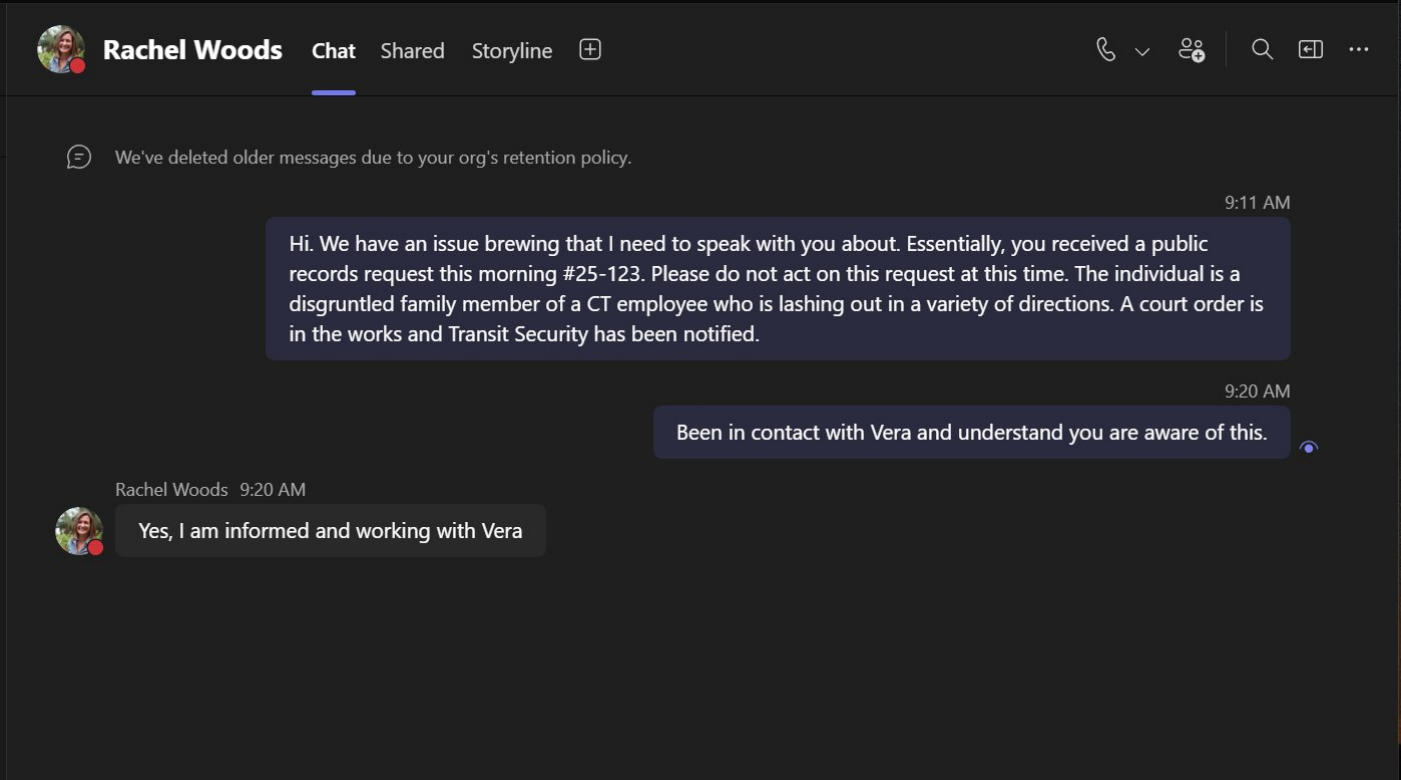
The "court order" Mr. Berman referenced was my mother's still-pending family-court protection-order petition. The IT Senior Manager of a Washington public agency instructed the agency's Public Records Officer to refuse a Washington Public Records Act request because his supervisor's personal family-court matter was in the pipeline. The Public Records Officer accepted the instruction. The Washington Public Records Act, RCW 42.56, does not give an agency the option to suspend a request because a private state-court matter between the IT Director and her son is "in the works." That is not a recognized exemption. That is bad-faith withholding under controlling Washington Supreme Court precedent and it subjects the agency to per-day per-record statutory penalties.
Document 2. Ten days later, on Monday, June 16, 2025, at 10:28 a.m., the petitioner — Deanna Tapia, Community Transit IT Director and the petitioner in Tapia v. Meyers — sent the following email from her agency email account to the agency's Public Disclosure Officer, Rachel Woods, requesting that the agency process a Public Records Act request for her personal family-court hearing.
To: Rachel Woods <Rachel.Woods@commtrans.org>
Date: Monday, June 16, 2025, 10:28 AM
Subject: Records Requests
Hi Rachel,
I have an upcoming hearing and would like to request all emails from May 29th and June to date sent to me and anyone else in the agency from any of these email addresses:
[Nine specific email addresses associated with the respondent are listed here. The addresses are omitted from this published excerpt for the respondent's privacy; the unredacted document is on file with the author and Community Transit.]
Thank you in advance.
De Tapia
Director - IT
Source: Community Transit Public Records Production, Request 25-168 Part 2, 2nd Installment (released February 25, 2026).
The IT Director of a Washington public transit agency, the same person who is the petitioner in a private family-court matter against her son, used her agency's Public Records Act process to gather, for her own personal litigation, all communications to or from her son's known and suspected email accounts over the period covering the underlying family dispute. She did not bring a subpoena. She did not engage personal counsel to make a public-records demand from outside the agency. She emailed her agency's Public Disclosure Officer directly, from her agency email account, requesting the production for her personal hearing.
This is the document that disposes of the petitioner's "harassment via public records requests" theory on its own terms. The petition asks the court to enjoin the respondent's Public Records Act activity as harassment of the petitioner. Document 2 shows that the petitioner was the first to weaponize the agency's Public Records Act infrastructure for private litigation purposes — using public-employee staff time, her own direct subordinate, and the agency's official records-processing system to gather litigation evidence for her personal family-court matter. The party asking the court for a clean-hands equitable remedy is not the party with clean hands.
The hypocrisy is structural, and it is the most important fact in the entire renewal hearing.
The Washington Public Records Act is the only reason the petitioner has the evidence on which she is asking the court to enjoin the respondent's use of the Washington Public Records Act. The emails the petitioner submitted to Snohomish County Superior Court as Exhibit H of her 71-page response packet — the bouncing emails to the non-existent agency domain, the measured letter to Sheryl Olson — were produced to her by Community Transit in response to the personal PRA request reproduced as Document 2 above. They reached her hand because she invoked the same statute her petition asks the court to label "unlawful harassment" when invoked by her son.
The petition's logical structure is therefore self-defeating. If Public Records Act activity constitutes "harassment" as a matter of law, the petitioner's own conduct in obtaining the evidence she relies on constitutes harassment. The petitioner cannot, at the same hearing, both (a) ask the court to enjoin a class of activity as unlawful and (b) rely on the same class of activity as the evidentiary foundation for the requested relief. If the activity is unlawful, the evidence is the fruit of unlawful activity and the court cannot consider it. If the activity is lawful, the petition's substantive premise collapses. There is no third option that survives basic statutory analysis.
While the agency was, by Mr. Berman's contemporaneous written directive (Document 1), suspending the respondent's Public Records Act request because the petitioner's family-court matter was "in the works," the same agency, by the same IT Senior Manager, on the same Microsoft 365 tenant, was processing the petitioner's parallel Public Records Act request in nine hours of elapsed time and one hour of staff time, to assemble the very evidence she would submit the next day in support of the family-court matter the agency had cited as its reason to refuse the respondent's request. The agency's two-track handling of the same statute — slow and obstructed for the citizen, instant and accommodating for the IT Director — is the picture the renewal petition would prefer the court not look at.
The Washington Public Records Act does not have a two-track procedural posture. It has one statute, one set of duties, one set of timelines, and one set of statutory penalties. The agency's contemporaneous internal communications make plain which track was applied to which requester. That selection itself is the disparate-treatment evidence the renewal petition asks the court to permanently insulate from continued examination.
Document 3. Ms. Woods's response, the same morning:
To: Mike Berman <Mike.Berman@commtrans.org>
Date: Monday, June 16, 2025, 11:21 AM
Subject: FW: Records Requests
Thanks for your help processing this request. Thanks for sharing those files with me as well and I'll enter all of this in Next Request. Please also provide the staff time spent on processing this request.
Rachel
Source: Same PRA production.
The Public Disclosure Officer immediately routed the IT Director's personal-litigation PRA request to the IT Director's own direct subordinate, Mike Berman, the agency's Senior Manager of Technology Infrastructure Services. By 11:21 a.m. — less than an hour after the IT Director sent the email — Mr. Berman had already begun processing the request.
Document 4. Mr. Berman's completion confirmation, the same day, 12:37 p.m. PDT:
To: Rachel Woods <Rachel.Woods@commtrans.org>
Date: Monday, June 16, 2025, 12:37 PM PDT
Subject: RE: Records Requests
This will complete that request and I will be FTP'ing them to the requestor. Time spent, 1 hour.
Mike
Source: Same PRA production.
The IT Director's personal-litigation Public Records Act request was identified, processed, completed, and transmitted to her by the agency in approximately two hours, with one hour of staff time logged. My own accountability-focused Public Records Act request, No. 25-123, filed ten days earlier on June 6, 2025, was processed over the following several months in rolling installments and remains incomplete eleven months later. The disparate-treatment comparator is the agency's own document.
Document 5. In a parallel exchange the same morning, Ms. Woods reached out to Mr. Berman about my Public Records Act Request 25-123. Mr. Berman's response, on the record, in writing:
To: Rachel Woods <Rachel.Woods@commtrans.org>
Date: Monday, June 16, 2025, 11:02 AM
Subject: RE: Search for Records: Request 25-123
I do. I have email in both my sent and deleted as well as Teams chat between me and you, and me and De Tapia. In addition, an email redirect was put in place during this time and updated for emails received from email accounts used by Henk Meyers.
Mike
Source: Same PRA production.
That single sentence — written by a Senior Manager of Technology Infrastructure Services at a Washington public transit agency to the agency's Public Disclosure Officer — admits three things in writing.
First, it admits that the IT manager has agency emails about the respondent in his deleted folder. Records in a public employee's deleted folder, after a litigation hold was triggered by the underlying federal-action filing and accompanying preservation demand, are records the agency has a written obligation to preserve and produce. The casual mention is itself a Public Records Act issue.
Second, it admits that the IT manager has Teams chats between him and the agency's Public Disclosure Officer, and between him and the petitioner, about the respondent. The Teams chats with the Public Disclosure Officer are the missing companion records the agency has been challenged to produce for months. The Teams chats with the petitioner — Mr. Berman's own direct supervisor — are documentary evidence that the supervisor used the agency's internal communication infrastructure to coordinate with her subordinate about the conduct of her personal litigation against her son.
Third, and most significantly, it admits, in writing, that the agency configured an email redirect targeting the respondent's email accounts — "an email redirect was put in place during this time and updated for emails received from email accounts used by Henk Meyers." That is the agency's Microsoft 365 transport-rule surveillance infrastructure, in the agency IT manager's own confessional written description. The rule the agency's April 29, 2026 demand letter (Dkt. 42-1 in the federal action) described as redirecting "any messages coming from or about Henk Meyers" to a Transit Security mailbox has its written acknowledgment, by the IT manager who configured it, in this single produced email.
Document 6. Mr. Berman's follow-up the same afternoon, 3:08 p.m. PDT:
To: Rachel Woods <Rachel.Woods@commtrans.org>
Date: Monday, June 16, 2025, 3:08 PM PDT
Subject: RE: Search for Records: Request 25-123
I should also say I the Barracuda has the original emails sent to CT personnel from several external email accounts associated with this individual. You now have those under separate cover for a different public records request.
Mike
Source: Same PRA production.
This is the closing admission. Mr. Berman tells the Public Disclosure Officer, in writing, that he had also pulled from the agency's Barracuda email-security logs the original emails I had sent to Community Transit personnel — and that he had provided those records to Ms. Woods "under separate cover for a different public records request." The "different public records request" is the IT Director's personal-litigation request from earlier the same morning, the one Mr. Berman completed in one hour and FTP'd directly to her.
The emails Mr. Berman extracted from the Barracuda logs and delivered to the petitioner for her personal hearing are, by his own description, the same emails the agency had logged as undeliverable to the wrong-domain recipients. They are the same emails Mr. Berman later assembled, signed, and submitted on Community Transit's official letterhead as Exhibit H of the petitioner's 71-page protection-order response packet filed in Snohomish County Superior Court on June 17, 2025.
The petitioner used her agency's Public Records Act process to obtain the documents her IT subordinate would then assemble on agency letterhead for filing in her personal family-court proceeding. The IT subordinate, the same one who configured the agency's surveillance redirect rule, processed both requests in writing on the same day from his agency email account. The Public Disclosure Officer, by her own contemporaneous response, accepted the workflow.
That is the conduct underlying the petition the court will rule on Friday. It is the conduct the order has, since June 2025, been used to shield from disclosure. It is the conduct the renewal petition asks the court to permanently insulate from continued exposure under the Washington Public Records Act.
The record is the agency's own document.
What the Court Will Be Asked to Decide
The court on Friday morning is not, in the end, being asked to decide a family matter. The court is being asked to decide whether the protection order that should never have issued in the first place — entered on June 18, 2025 over the respondent's preserved constitutional objection — will be allowed to continue in force as a permanent feature of Washington law applied to one specific citizen, on the basis of a petition that enumerates federal civil rights litigation and Washington Public Records Act activity as the "harassment" the petitioner asks the court to enjoin.
The First Amendment forbids the order. Near, on the prior restraint dimension. NAACP v. Button and Bill Johnson's, on the federal-litigation dimension. Houchins v. KQED, on the public-records dimension. New York Times v. Sullivan, on the public-employee-commentary dimension. The doctrines are not in tension. They converge on a single conclusion: the order the renewal petition asks for is one no state court has the authority to enter.
The statute, on its own terms, does not authorize the order. RCW 7.105 reaches "unlawful harassment," which requires a course of conduct that "serves no legitimate or lawful purpose." Federal civil rights litigation serves a legitimate and lawful purpose by statute. Public Records Act requests serve a legitimate and lawful purpose by statute. Public-employee criticism serves a legitimate and lawful purpose by constitutional doctrine. The petition's catalog of "harassment" is, in each element, the catalog of activity the statute exempts from its reach.
The petitioner's counsel — a Washington-licensed attorney whose profession removed him from judicial office six weeks before he took this case, in an en banc Supreme Court opinion finding that he had engaged in "flagrant and intentional" misuse of judicial power and ongoing dishonesty before tribunals (In re Disciplinary Proceeding Against David Ruzumna, Judge Pro Tempore, No. 202261-8, Wash., en banc, April 9, 2026) — will appear and ask the court to grant the permanent order anyway. The point of including Mr. Ruzumna's disciplinary history in this analysis is not to attack his character. It is to expose the petitioner's selection strategy. The legal arguments required to uphold a state-court order that permanently enjoins federal civil rights litigation and Washington Public Records Act activity are so fundamentally incompatible with controlling First Amendment doctrine and the statute's own definitional exclusion that only an attorney with a documented and recently-adjudicated history of disregard for judicial integrity would be willing to stand before a Washington bench and advance them. The lawyer's identity is the consequence of the argument's constitutional defects, not their cause.
The court has the documentary record. It has the petitioner's own sworn enumeration of what she wants enjoined. It has the agency's own contemporaneous threat assessment, naming the actual concern as speech. It has the agency's June 4, 2025 internal email proposing to "deny any public comment from this individual per the court order despite it being unserved" — a document, produced under the very Public Records Act requests the petition seeks to suppress, that admits the unconstitutional motive in writing. It has the petitioner's own sworn testimony from the June 18, 2025 hearing that the agency's Threat Assessment Team had already blocked the very communications the petition characterizes as harassment.
The constitutional analysis is not difficult. The procedural posture is not novel. The doctrinal authorities are not contested. The only remaining question is whether the court that deferred the constitutional question a year ago will defer it again, or whether it will, this time, apply the doctrine the deferral implicitly acknowledged was at issue.
A court that defers a constitutional question once may be acting on docket-management grounds. A court that defers the same question a second time, in the face of the petitioner's request that the deferred restraint be made permanent, has chosen something else.
The harassment is non-existent. The prior restraint is real. The court has known it for a year, because the constitutional argument was raised on the record at the original hearing, deferred, and never resolved. The order entered in the wake of that deferral should never have entered. Friday morning is the court's first opportunity to correct that. It is not the moment the constitutional defect appears. It is the moment the constitutional defect either ends or is made permanent.
The audio recording of the June 18, 2025 hearing was obtained by the author by formal request from the Snohomish County Superior Court and is the primary source for every quoted exchange above. The hearing was open to the public. Audio clips are being prepared for inline embed in a subsequent update to this article.
The hearing on the renewal petition is set for Friday, May 29, 2026, at 9:00 a.m., Snohomish County Courthouse, 3000 Rockefeller Avenue, Everett, Washington, Courtroom 1C or 1D as assigned. Public hearings are open to the public.